
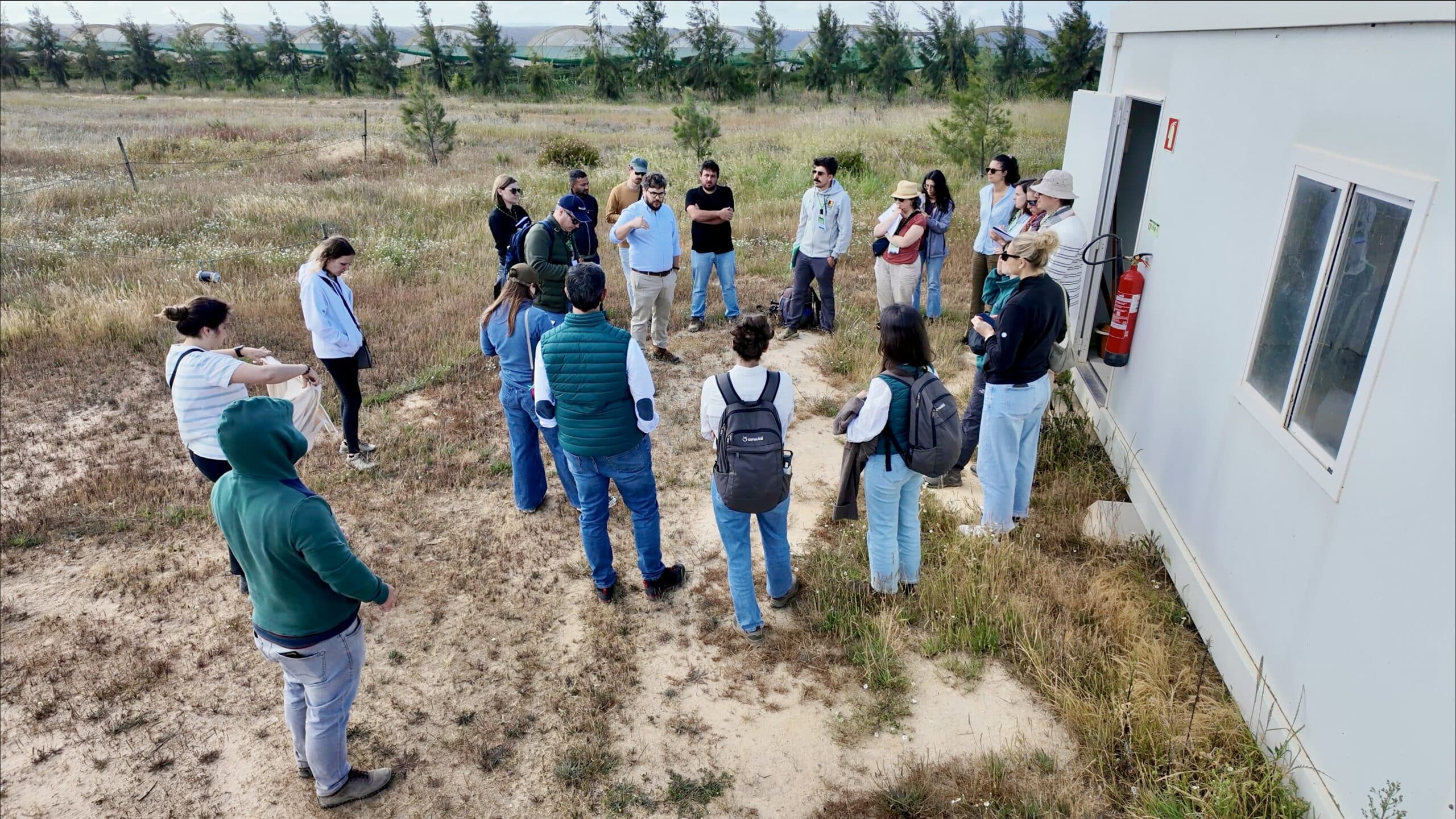
The Climate Farm Demo cross visit organised by CONSULAI and held at TSBC Portugal brought together farmers, advisors and project partners for two days of peer-to-peer exchange. As part of the project’s efforts to promote practical knowledge sharing on climate change mitigation and adaptation, the visit focused on water management – one of the 12 Adaptation and Mitigation Thematic Areas of the Project – as a key challenge for Mediterranean agriculture facing increasing water scarcity.
The event was officially hosted by The Summer Berry Company Portugal, welcoming participants to its production facilities to showcase how sustainable water management practices are being integrated into modern berry production systems. The programme also included field visits to FRUPOR and Herdade Monte Branco da Loira, where participants explored a diverse range of production systems, including raspberries, vineyards, horticultural crops and the Montado system.
A key highlight of the cross-visit was that effective water management must be adapted to local conditions, while still drawing on knowledge shared across Europe. Participants also reflected on the close connection between water management, soil health and biodiversity, observing how practices such as organic inputs, cover crops, hedgerows and vegetation cover can improve water retention, regulate flows and help protect water quality.
The visit showcased concrete practices already in use on the host farms, including open and closed irrigation circuits, water treatment systems with filtration and disinfection, rainwater collection and storage solutions, grass cover in vineyard inter-rows, and ecological focus areas that support both biological control and water protection.
As host of the cross visit, The Summer Berry Company Portugal presented its own sustainability journey and investment in water efficiency. The company has achieved more than 60% self-sufficiency in water usage through the development of rainwater collection and storage infrastructure, helping reduce reliance on external water sources. In parallel, advanced recirculation systems allow unused water and fertilisers to be recovered, treated and reused within the production cycle, significantly improving resource efficiency and reducing environmental impact.
The Portuguese cross-visit will contribute to strengthening knowledge exchange across the Climate Farm Demo network. The lessons learned are expected to inspire participants to share and adapt the observed practices in their respective countries, supporting a better understanding of climate-smart approaches under diverse farming and environmental conditions.